
SDAIA AI Compliance: What Every Organization in Saudi Arabia Must Understand Before 2026
- 26.06.2026
- Posted by: Pokrajac
- Category: Uncategorized
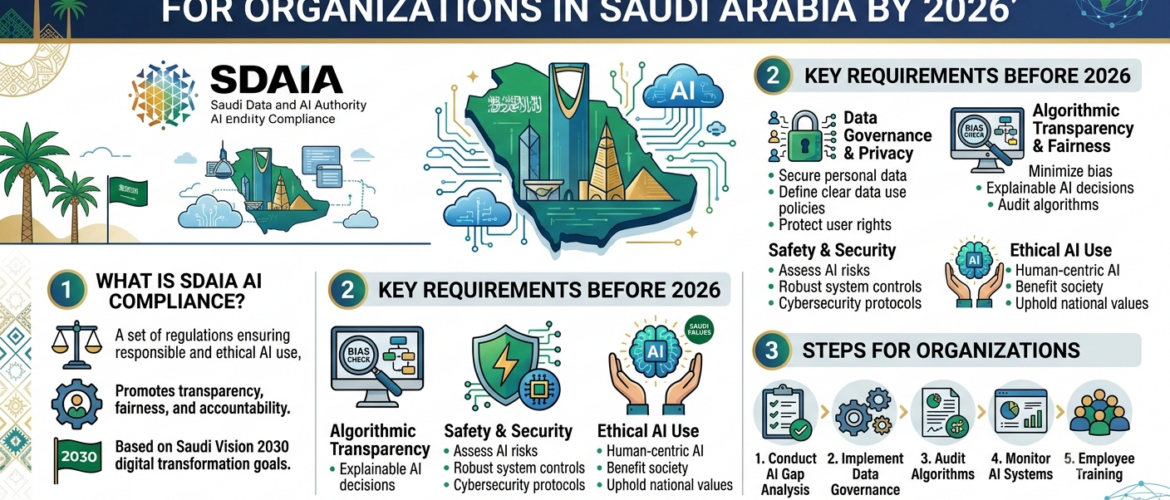
SDAIA AI Compliance: What Every Organization in Saudi Arabia Must Understand Before 2026
AI is moving fast in the Kingdom. The regulatory framework moving with it is not optional and most organizations are asking the right questions too late.
AI is moving fast in the Kingdom. Billions are being deployed. Use cases are multiplying. Public sector entities are under mandate. And somewhere in the middle of all that momentum, most organizations are asking the same question too late: Are we actually SDAIA-compliant?
What is SDAIA?
SDAIA — the Saudi Data & AI Authority is Saudi Arabia's primary regulatory body governing how data is collected, processed, and used, and how artificial intelligence is adopted across public and private sectors.
Established under Vision 2030, SDAIA governs the National Strategy for Data and AI (NSDAI), which targets over SAR 74 billion in GDP contribution from AI by 2030. That ambition is backed by enforcement infrastructure and that infrastructure is getting harder to ignore.
The SDAIA AI Adoption Framework 2024
In September 2024, SDAIA published its AI Adoption Framework a mandatory governance structure for public-sector organizations and an increasingly expected standard for any organization seeking government procurement contracts through the Etimad portal.
The framework is organized around five governance pillars. None are decorative. Each requires documented, signed, version-controlled evidence.
Data Governance
All data used to train, fine-tune, or operate an AI system must be lawfully sourced, classified per NDMO sensitivity levels, and fully auditable. PDPL Article 18 data residency requirements apply for public-sector deployments.
Model Accountability
Every deployed AI system must have a named accountable owner, defined performance metrics, and a 72-hour breach notification protocol (PDPL Article 29). Accountability must be named not diffuse.
Transparency
Users must know they are interacting with AI. For systems deployed in the Kingdom, Arabic-language disclosure is mandatory not preferred. Generative AI requires content authenticity controls and watermarking.
Human Oversight
Every AI system must have a functioning kill-switch and named override authority. Human oversight is not a feature added after deployment it is a design constraint applied from day one.
Risk Management
Use cases are classified into four tiers: Prohibited, High Risk, Limited Risk, Minimal Risk each with proportional governance requirements. High Risk systems require a DPIA and annual independent audit.
The AI Office: Non-Negotiable
Before any of the five pillars can be addressed, SDAIA requires every adopting organization to establish a formal AI Office with executive sponsorship and defined roles. No AI initiative in the Kingdom is compliant without this structure in place regardless of how sophisticated the technology is.
The Regulatory Ecosystem
SDAIA does not operate in isolation. Every organization in the Kingdom must navigate a broader regulatory lattice. Each of these instruments is a gating criterion not background context.
What is Coming in 2026
The current framework primarily targets public-sector organizations. But the Draft Responsible AI Policy which underwent public consultation closing in May 2026 — makes the direction unmistakable.
Private-sector expansion is expected before the end of 2026. The draft introduces a four-tier risk classification binding on private entities with enforcement mechanisms. Organizations that have deferred compliance because "it doesn't apply to us yet" are running out of runway.
The cost of building compliant AI practices now is a fraction of the cost of reverse-engineering evidence under a procurement deadline or a regulatory review.
The Failure Pattern to Avoid
The most common mistake: building an AI system first, then assembling compliance evidence before a tender or an audit. Documentation assembled after the fact is incomplete, unsigned, and unconvincing to a reviewer who knows what audit-ready evidence looks like.
Every phase of an AI adoption engagement should produce a documented artefact. Every artefact should map to a specific pillar. Every pillar should trace to the SDAIA clause, PDPL article, NDMO level, NCA control family, or ISO/IEC 42001 control from which the obligation derives.
Organizations that get this right receive an audit-ready 12-document Evidence Pack at engagement close — handed directly to an SDAIA reviewer without additional rework. Organizations that get it wrong find out at the procurement review.
Not Sure Where Your Organization Stands?
SDAIA-Compass is an AI agent built to help you navigate these requirements — pillar by pillar. Ask it about your use case, risk tier, which documents you need, or simply where to start.
Ask SDAIA-Compass → No sign-up required · Ask your first question in 30 secondsCo-Founder & CAIO at AIMAN Technology DOO · Creator of the SDAIA Compliance Evidence Pack methodology · AI education architect working across the GCC region and EU. Connect on LinkedIn →